
violation
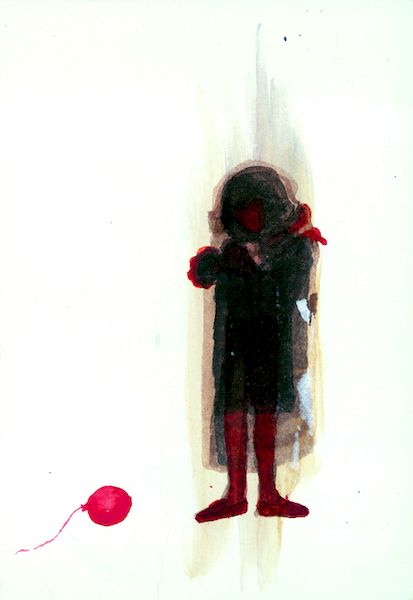
- year: 2005
- start: 2005-04-29
- end: 2005-05-28
- artists: arzu başaran
The inspiration for the show is my collection of pictures of children and adolescents cut out from the third page news section of Turkish newspapers where violent crimes are featured. The main theme of the show is the way centers of power such as the press, state and even the public eye objectify the bodies of children and adolescents.The real questios behind the show's theme are making what's fleeting, from objects to authorities, permanent, digging through memory and facing the findings.
The general structure of the show has emerged from my concerns over how to transfer the photos I had chosen in a style not my own and how to install the works in keeping with the theme.Almost all the works in the show are drawings made up of lines and stains on paper.arzu başaranTHE LIKENESS IN THE IMAGELevent ÇalıkoğluWhat sort of relationship can be established between, on the one hand, the act of bringing to life a face that is concealed in one's memory and, on the other, looking insistently at a living, breathing face? Is it possible, by examining a face imprisoned within an image, to construct a common denominator with the act of imagining faces that have no owners?The faces in Arzu Başaran's last exhibition come from out of the unknown. They were 'discovered'' likenesses: likenesses whose presence there was hypothesized. This time the artist anonymizes lost faces that are cowering in newspaper images as she turns to reaching beyond portraits that are printed and thus belong to a surface and from there to construct a common memory. By rendering pictorially that which is imagined, this point of view eschews the experience of acquiring a face and countenance for it in favor of the 'headshots'' that accompany page-three newspaper items: its target essentially is the anonymous.Arzu's first venture with faces was concerned with those that could be plucked from memory. Painting was a field of endeavor in which a face that had become lost to memory (wouldn't it be more correct to say that it hadn't been properly installed in memory?) might pop up and reveal itself. But the point at which a face seeking a veil for itself within layers of transparencies became visible was, like the place from which it had come, ambiguous. These were faces that bore no indications of who they might be. They were simply faces that the viewer saw and, for that reason, their identities came from outside the image itself: their identities were proposed to or imposed upon them instead. In the final analysis they were merely non-existent superficial shells (a resemblance suggested by the brown tones of those pictures); they were the images of a 'non-existent'' someone whom I knew I would never encounter in real life.The faces I see this time however belong to 'here'' and-even if I can't put my finger on the exact moment-to 'now''. These are faces that are the subjects of events that are dire, unfortunate, absurd: events that we always suppose 'happen to someone else''. They are merely secondary illusions: created from snapshot portraits-pictures such as you might carry in your wallet as a keepsake or pull out of a frame because they're needed-as they would appear if published in a newspaper. The artist has neither the face nor its photograph and the image is actually only a 'pointer'' that has been summoned up and set beside a news item as a kind of witness so that the reader can establish some sort of a relationship with the event. It is an image that is unburdened by any place or time that the artist may have seen and in fact it belongs neither to the reality of the moment of the event nor to the surface of the newspaper. Like the headshot format itself, these photographs are fraught with cultural codes: a school smock with a disheveled collar; hair finely combed and parted with butterfly-motif barrettes at each end; jackets and shirts whose tailorings and styles inspire a sense of datedness? They resemble images plucked from the 'Who's who'' pages of school yearbooks. Adults see their own childhoods in the faces of the children and remember. The photographs possess this untimeliness-as photographs. But these photographs are not all that innocent: they don't shout out; but they do wound.These are faces that become stereotypical however much they may impinge upon the fragile points of one's memory: faces such that each one loses itself in the next. The artist spent several years hunting them down in the page-three stories of newspapers and from them she has created an album of photo-faces that are not of this world. These faces have smiles, countenances, looks, and personalities that are unique unto themselves. Untrammeled by origin or association with the news items that they accompany, they are, like all the photographs illustrating other stories in the newspaper, simply a record, a document, or a keepsake for those who know the owner of the face. One's first impression is that the reason they all resemble one another however is not just the fact that they're all headshots. This impression is related to the fact that they are clichéd expressions as elements of the same news format and have been subjected to a secondary stereotyping as printed material. Even if a name is given in the caption (situations where only the first and last initials are given may protect the individual's privacy but are still incapable of preventing his anonymization and transformation into a 'case study'') it has still become the face of a person who is no longer living and breathing: a face belonging to the artificiality of printed materials. It is no longer a corporeal, bodily being but only a lifeless 'thing'', a pointer, that becomes increasingly more remote from any palpable reality. The fact that these photographs frame what is the most talked-about part of the body-the face-may impart cultural and psychical meanings as well as a value system for the viewer but ultimately they point to nothing more than an isolated moment of reality. They convey no more knowledge than whatever aura may have been imparted to them by the combination of camera, photographer, subject, and location by which they were created. The information they reveal as a part of the newspaper on the other hand sends the aura compressed into that tiny frame right back into the news item itself. The photograph is not merely associated with the news item as an unconvincing bit of news (nobody can stand seeing the mangled faces of children): it also imprisons within the confines of the newspaper all the words that might come into one's mind.In her previous portraits, the artist abandoned the faces coming from 'the unknown'' to the hegemony of an external point of view. In these however she has done exactly the opposite and strives to ensconce herself in faces whose appearance is plainly obvious. Passing through a discourse suspended over printed materials, she turns to establishing a common lexicon (however impossible that may be). It's quite evident that the artist wants to draw attention to these faces. Inasmuch as she has purged them of every embellishment and placed them on the surface of the paper with a ghostlike sort of illumination, she wants to say something about their existence. In some of the pictures I get hung up on the children's' stories (and in some faces the stories are excruciatingly explicit); in others, it's a lip or a nose that captivates me. Seemingly familiar children's faces that I try to recall are limned in a pale blueness in that no-man's-land (or should I say 'Limbo''?) between drawing and painting and then fade away because they're parts of a story that I don't know. Many of the faces in the news items that the artist hunted down suddenly become images that I know I shall not be able to touch. Just as that which is real becomes artificial as it evolves into image, the body too can turn into spirit through the vehicle of image.In the artist's drawings, whose expressive lines are as sharply delineated as if made with a stencil, we are witness to another cliché that she has adopted from the language of the printed image. In these works, the faces disappear into a white void and the bodies adhere to the surface of the paper three-dimensionally yet somehow devoid of depth, thereby rendering visible the relationship between a free-floating sense of guiltiness and body language: here a diffident turning of a foot; there an involuntary but genuine posturing of a body. To be honest it's impossible to say whether such things are a reaction to the photo-correspondent's camera threatening to pierce the subject's privacy (how interesting that a mechanical point of view should lay bare the defenselessness of a delicate frame) or are the result of bodily reflexes. Nevertheless this clichéd pose produced by the printed material associated with the news item sets off question marks that a passive-inert viewer might not want to think about. This innocent and genuine body language that the photograph has discovered and repeats from one example to the next points to an emptiness from which the artist has withdrawn. While the portraits show the depth through which the artist has passed, the emptinesses here reveal the things that were left outside to be confronted. Inasmuch as a face must belong to a body, imagining a body without a face is to leave the body speechless, just as Arzu has done here. From this point on, the words that are needed for that confrontation are henceforth to be found at the place that the viewer-not the artist-has the courage to reach.


